AI Technology, Inc. (AIT) pioneered the manufacturing of self-supporting die-attach film adhesive without fiber-glass support as early as 1980’s. It’s conductive and non-conductive film adhesives have been used in semiconductor die-attach applications. AIT’s stress absorbing polymer technology with molecularly engineered epoxy and cyanate ester is well-known in the highest reliability applications.
AIT is offering an enhanced versions of the Thermal Compression Non-Conductive Film (TC-NCF) that are designed to enable advanced semiconductor packaging, particularly in:
- High Bandwidth Memory (HBM)
- 2.5D and 3D IC integration
- Chip-to-wafer (C2W) bonding
- Chip-to-substrate thermocompression bonding (TCB)
- Hybrid bonding support processes
- Advanced AI processors modules
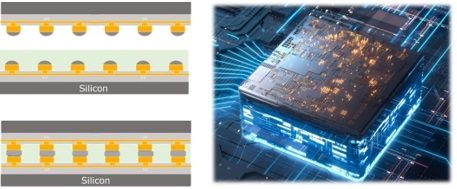
Unlike conventional capillary underfills, TC-NCF is a pre-formed adhesive film that is laminated onto the die before bonding. During thermocompression bonding, the film simultaneously acts as:
- Adhesive
- Electrical insulator
- Underfill
- Mechanical stress buffer
- Flux carrier (optional)
The use of TC-NCF film adhesive technology significantly simplifies assembly while improving reliability. For the next 5–10 years, TC-NCF is expected to remain the dominant material for micro-bump-based thermocompression bonding, particularly in HBM and advanced heterogeneous integration. The advanced NCF-TC7880 and NCF-TC7860 offers some of the unparalleled among the industry using polymer engineering to control its CTE to 10-22 ppm/ºC without the use of fillers that may hindered the finest pitch chip to wafer thermal compression soldering and bonding.
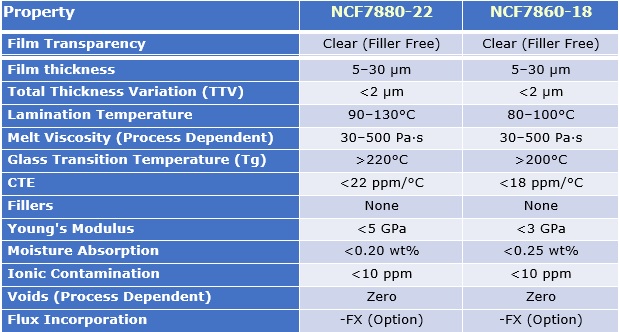
The following is a table summarizing the key properties of AIT NCF7880-22 and NCF7860-18 film adhesive that uses polymer engineering to achieve CTE of 22 and 18 ppm/C to provide the necessary compressive restraint to prevent copper-solder fatigue and without inducing excessive shear stress and warpage of the stacked chip packaging.