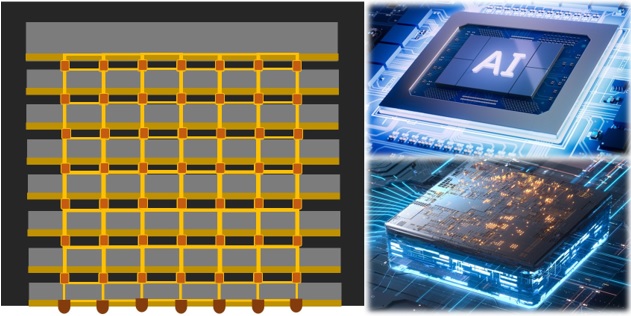
Molding underfill (MUF) or also commonly refers to as mass reflow-molded underfill (MR-MUF) is one of the more important enabling materials for advanced semiconductor packaging, particularly HBM (High-Bandwidth Memory) modules, 3D DRAM stacking, and increasingly chiplet-based AI processors.
Rather than dispensing capillary underfill after solder reflow (capillary underfill), MUF may be after soldering or in combination with the solder reflow and encapsulation processes using heated forced underfilling with molding encapsulation method similar to the more traditional molded encapsulation. In the MUF process, a specially formulated liquid epoxy molding compound (EMC) or liquid molding compound (LMC) that has much lower viscosity and much smaller CTE and/or thermal modifying particulates are used. The injection forced flow significantly improving manufacturing throughput. With proper engineered polymer and fillers to provide lower CTE, stress relief capability, and lower moisture absorption the package reliability can also be optimized.
AI Technology, Inc. (AIT) is known for its technology in molecularly engineering of polymer technology for stress relief while maintaining low or high modulus for different applications. This technological capability enables AIT to offers non-filled and non-conductive film adhesives for stacked chips with low stress.
AIT is also the first company in providing compressible phase-change technology with special engineered thermal fillers including diamonds and boron nitride to provide the ultimate thermal management solutions that include capillary underfill for gap of less than 10µm. Coupling the same polymer technology with intrinsically low CTE and nano-thermal conductor technology, AIT is able to offers some of the unparallelled solutions for molded underfilling solutions for HBM, chiplet and AI-3D modules manufacturing and reliability.
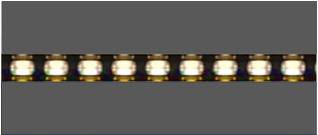
The following some of the innovations incorporated in the MUF solutions by AIT
- Thermal conductivity of boron-nitride based MUF-7866-8 of 4 W/m-ºK, and diamond-based MUF-7869-8 of 8 W/m-ºK without affecting flowability like those solutions in capillary solutions.
- The nano-based thermal filled solutions have been proven in the less than 10 µm pitch-gap capillary solutions
- The low CTE polymer technology coupling with the CTE-thermal nanotechnology to achieve 8 ppm/ºC for MUF-7866-8 and MUF-7869-8 to dramatically reduce package warpage and compressive stress for copper and solder joint reliability with low shear stress.
Combinations of low CTE, low ionic impurities, low moisture absorption molecular structure, AIT MUF provide efficient molding underfilling and unparalleled reliability.
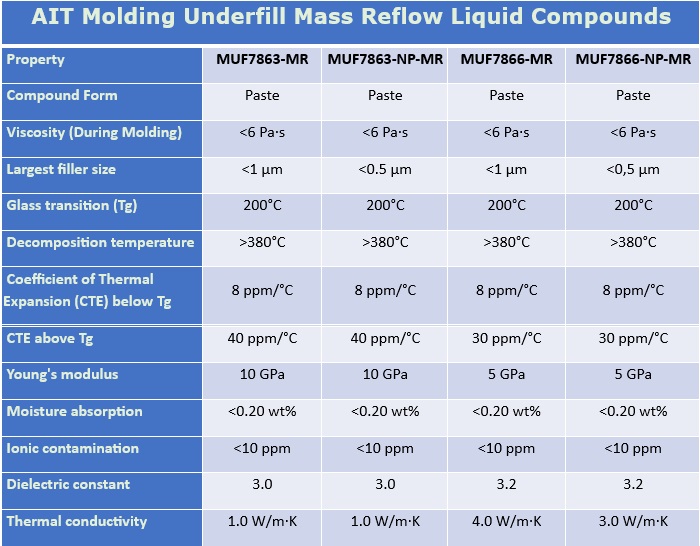
The following table is a summary of the MUF liquid mass reflow (MR) solutions offered by AIT:
Molding Underfill (MUF) for Compression Melt-Flow Film and Sheet Underfilling-Encapsulation Compound with Thermal Dissipation Enhancement
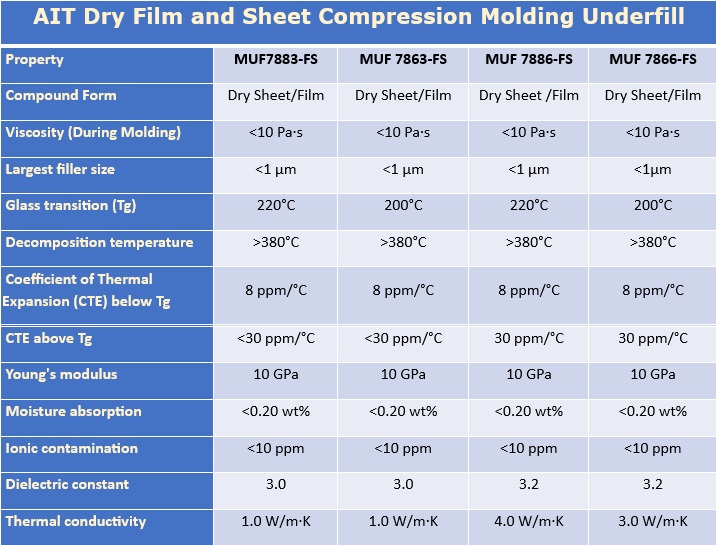
Compression molding underfill is one of advanced semiconductor packaging materials requiring extreme polymer and fillers optimization. Driven by HBM, AI accelerators, chiplets, Fan-Out Panel Level Packaging (FOPLP), and large flip-chip packages, this compression molding underfill must balance the melt-flow ease with CTE matching between chip and copper-solder joints, and more and more endowed with higher thermal dissipation. Unlike conventional epoxy molding compounds (EMCs), this solid form of film and sheet materials are engineered to flow into die-to-substrate gaps as small as 10–30 μm while minimizing shear stress induced warpage while balanced with compression stress relief for copper-solder joints.
AIT pioneered the first die-attach self-supporting and stress absorbing epoxy film adhesive in 1980’s. In recent years, AIT also established itself with some of the most advanced and proven capillary underfill with cyanate ester polymer technology. Coupling AIT’s stress absorbing polymer technology based on cyanate ester and epoxy that intrinsically engineered to have lower CTE and special nanotechnology fillers from silica and boron nitride to achieve some of the unparalleled advantage in CTE around 8ppm/ºC while maintaining low moisture absorption and ionic impurities.
AIT’s dry film and sheet molding underfills (MUF) with silica and boron nitride nanotechnology are designed for compression melt-flow for wafer and panel level underfilling and encapsulation before dicing into individual packages.
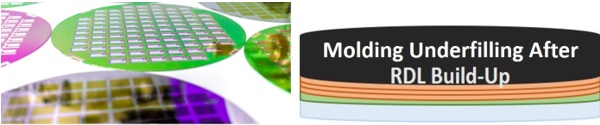
Compared with conventional compression molding underfill (MUF) used at the package level, WLMUF must satisfy much more stringent requirements for wafer warpage, thin-film uniformity, fine-feature filling, and compatibility with redistribution layer (RDL) structures.
AIT’s film and sheet wafer and panel level molding underfills are ideal underfill encapsulant for:
- Fan-Out Wafer-Level Packaging (FOWLP)
- Fan-Out Panel-Level Packaging (FOPLP)
- Wafer-Level Chip Scale Packaging (WLCSP)
- Chip-first and chip-last fan-out packaging
- Advanced AI and mobile processors
- RF and mmWave devices
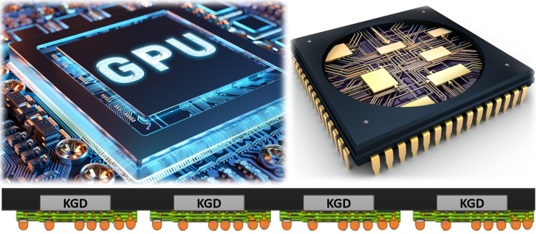
The following table is a summary of the compression moldering underfill (MUF) dry film and sheet solutions offered by AIT: