
Combing Front Sheet Glass Protection with UV Resistant Moisture Barrier Encapsulant
Standard Solar Panels are composed of a front sheet with low iron tempered glass and EVA encapsulant. This structure offers many benefits but poses a significant drawback, namely weight; the glass sheet is heavy. The thick EVA encapsulant takes a melting and curing cycle time at temperatures of 140-160°C under vacuum for up to 15-30 minutes. Not only is the EVA encapsulant melting and curing time difficult to automate and thus a costly manufacturing process, but the thickness and the large free space of the polymer network of the EVA encapsulate contribute to a high moisture ingress at the panel edges as well as sensitivity to acetic degradation of the EVA encapsulant under heat and moisture leading to a high failure rate.
AIT’s SOLAR-THRU™ PVDF front sheet and SOLARIMB™ thermally conductive back sheet has the potential to change the paradigm of solar panel construction by completely encapsulating the front and back sides with a single melt-bonding process that dramatically reduces production time by as much as 10 fold. AIT’s SOLAR-THRU™ PVDF front sheet and SOLARIMB™ thermally conductive back sheet also enables roll-to-roll lamination production of thin film solar panels. Applying these melt-encapsulating processes with UV resistant moisture-resistant materials dramatically enhances the processing and performance of solar panels.
1. SOLAR-THRU™ is a modified PVDF thermoplastic polymer that has a proven higher solar transmission than glass, ETFE and FEP. Equivalent and similar materials have more than 40 years of performance under direct sun exposure.
2. SOLAR-THRU™ PVDF front sheet encapsulation adhesive instantly melt bonds to solar cells without an EVA interface layer during the same vacuum lamination process for solar panels. SOLAR-THRU™ PVDF front sheet encapsulation adhesive is designed to be used both as a protective layer in place of glass or ETFE and FEP as well as an EVA encapsulant. The ambient bond strength is well over 1500 psi on silicon and maintains substantial bond strength up to 110°C.
3. Besides having outstanding solar efficiency of over 96% transmission without glare, SOLAR-THRU™ PVDF front sheet encapsulation adhesive also eliminates the vulnerability of EVA to heat moisture decomposition with much lower moisture ingress and inert to moisture, temperature and UV combinations.
4. RoHS, REACH and WEEE compliant that meets UL94V-0 rating.
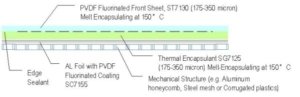
AIT patent-pending panel construction and process with thermoplastic melt-encapsulation has the potential to dramatically change the paradigm of solar panel manufacturing without changing the manufacturing infrastructure. The insulating metal thermal back sheet enhances thermal dissipation and solar panel performance on the hottest day.
Representative process:
1. Front and Back Sheets Handling
- SOLAR-THRU™ and SOLARIMB™ laminates can be stored in ambient conditions for at least 12 months (3-4 times longer than that of traditional laminates).
- No pre-staging is necessary.
2. Tabbing and Panel Preparation
- Tab and interconnect all solar cells in series into module
- If AIT conductive adhesive tabbing solution is used, the temperature of tabbing may be lowered to 150°C.
- Inspect and test for functioning
3. Front & Back Sheet Encapsulation
- Use flat and planar backing for the front sheet
- Vacuum or roll encapsulate the solar module of the front and back sheets either separately or together @150°C and close to 14 psi vacuum
- If roll-lamination is to be used, make sure that trapped air is repelled during the melt flow process.
- Inspection and QC for functioning
4. Inspection and Rework
- Make sure the back film adhesive has flowed to minimize trapped air bubbles
- The lamination process can be repeated in case less than desirable flow is observed
5. Trimming and Framing
- Trim off excess material that flowed out during manufacturing
- Frame the finished panel or use frameless support
6. Finishing Operation
- Inspect for quality
- Test and certify panel
SOLAR-THRU™: A Single Ply Fluorinated Melt-Encapsulating PVDF Front Sheet For Instant Melt-Bonding Lamination
At current, high vacuum forming time, costly materials and sub-par performance equates to disproportionately large manufacturing costs for producing solar panels. The physical challenges demand expert solutions and creativity from diverse disciplines to develop a solution.
With over 30 years of experience in formulating and manufacturing of specialty materials and adhesives for electronic applications, AIT has developed a series of fluorinated melt-encapsulating PVDF front and back sheets, UV resistant coatings, sealant-adhesives and conductive tabbing without soldering.
The melt-encapsulating fluorinated front and back sheets are coupled to allow 10 times reduction in vacuum laminating-curing processing time than traditional laminating-encapsulation of solar panels with EVA. With the introduction of SOLAR-THRU™ and SOLAR-THRU™ PVDF, AIT can assist solar panel manufacturers implement inline lamination processing rather than batch based vacuum encapsulation processing.
- Industry’s first low pressure, low temperature and instant melt-bondable thermoplastic encapsulating materials for inline encapsulation with lamination pressure.
- The same pressure lamination at temperatures of 140-160°C will complete the tabbing process of connecting the solar cells in series.
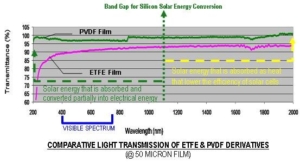
AIT SOLAR-THRU is a PVDF film which, like other fluorinated films, has a high resistance to UV disintegration without the use of organic UV absorbers. The use of this high transparency front sheet allows more spectrum of energy through to allow more energy conversion than the EVA encapsulant. The highest conversion efficiency is achieved without the glass front sheet if mechanical strength can be imparted by the back plane structure.
Front Sheet and Encapsulation Suggested applications:
- 375 micron film configuration for standard solar panel and tab
- 75 micron film configuration for thin film solar front sheet
- 175 micron film configuration for mono- and poly-crystalline solar panel with thin tab of less than 100 micron thickness
| Properties of SOLAR-THRU™ (ST 7130) Encapsulant Front Sheet | |
|---|---|
| Electrical Resistivity | >1014 ohm-cm |
| Dielectric Strength (V/mil) | >750 V |
| Dielectric Constant | 3.5/11 |
| Optical Clarity (Transmission @ 100 micron thickness) | >95% |
| Peel Strength with EVA (Pound/inch, cohesive failure) | >10 |
| Device (Silicon) Push-off Strength on glass (psi) | >1200 |
| Cured Density of Composite Dielectric (gm/cc) | 1.65 |
| Thermal Conductivity | > 0.2 W/m-°C |
| Linear Thermal Expansion Coefficient (ppm/°C) | 90 (X-Y=Z, Isotropic) |
| Elastic Modulus (psi) | 20,000 psi |
| Elongation Before Breakage | 300% |
| Maximum Continuous Operation Temp. (°C) | > 150 |
| Recommended Melt-Lamination Pressure/Temperature/Time (psi/°C/Second) | >15/>150/>0.5 |
AIT patent-pending panel construction and process with thermoplastic melt-encapsulation has the potential to dramatically change the paradigm of solar panel manufacturing without changing the manufacturing infrastructure. The insulating metal thermal back sheet enhances thermal dissipation and solar panel performance on the hottest day.
For a recommendation, information or assistance, please contact AIT sales and engineering:

AIT technical sales and service department can also be reached at: 1-609-799-9388 or 1-800-735-5040 (EST) and Fax: 609-799-9308