
TABBING INTERCONNECTIONS OF SOLAR CELLS IN SOLAR MODULE AND SOLAR PANEL
The cost of tabbing and the decreased reliability in performance caused by high temperature melt-soldering are two problems plaguing solar panel manufacturing and limiting solar energy cost effectiveness. AIT SOLAR-TAB™ provides a solution to high cost tabbing and high temperature melt-soldering.
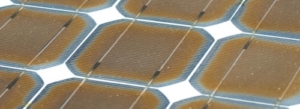
AIT SOLAR-TAB™ is designed to tab at a much lower temperature of 150°C with the same efficiency as soldering at 300°C. Tabbing can be performed with same equipment and process as soldering with slight pressure of 10 psi or better.
In normal soldering, temperatures can reach as high as 300°C, resulting in differential thermal expansion of the copper (@17 ppm/°C) with solder bonded onto substrates of silicon having CTE of 3 ppm/°C. Additionally, internal stress over one million of psi arises, thus forming micro-cracks that reduce field reliability and may lead to unpredictability and ultimately failure. When not controlled adequately, the solar cells can be warped and broken during manufacturing.
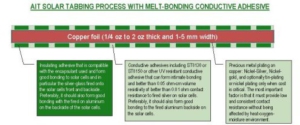
AIT SOLAR-TAB uses a specialty tabbing material with silver flash on copper with instant melt-bonding conductive adhesive to form joints between tab and solar cell contact silver traces.
AIT SOLAR-TAB™ solution is engineered to reduce known issues and reduces the costs of manufacturing:
Besides replacing traditional soldered tabbing with conductive adhesive tabbing, SOLAR-TAB™ with melt-bonding conductive adhesive on silver traces and tabs patterned on the melt-encapsulating front sheet is designed to form direct metallization on the TCO layer of solar cells without fired on silver-glass.
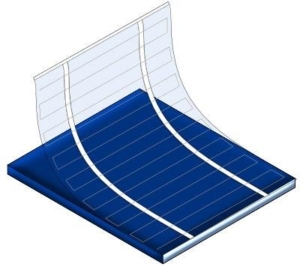
Instead of depositing and firing silver-glass on top of transparent conductive oxide (TCO ), conductive adhesive is deposited on the metal grid and tabs patterned on the transparent front sheet that can be laminated onto the solar cell to allow more efficient channeling of charges generated within the solar cell. AIT SOLARTHRU™ is a ready substrate for this process and accepts imaging and deposition of the copper with nickel passivation and silver contact surfaces. Thinner and closer tabs (for example, instead of 2-3, 4 tabs may be used) will minimize the electrical and optical loss.
- SOLAR-TAB™ provides the first instant melt-bonding tabbing solution that dramatically increases productivity, improves reliability and yields with low temperature processing of 150°C.
- The operation of melt-bonding (similar to soldering) occurs at a lower temperature of 150°C. Additionally, there is no need for fluxes or cleaning after soldering.
- The internal stress is relaxed to “zero stress” with the flexible conductive adhesive that has been proven by AIT in the semiconductor and military industry for over 25 years.
- The same ultra-low electrical resistance between the solar cells charge collection circuit is achieved similar to the soldered tabbing.
- Fluorinated polymer is used that has more than 40 years of proven solar and UV stability.
- RoHS, REACH and WEEE compliant that meets UL94V-0 rating.
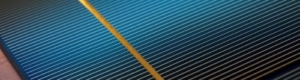
Properties of SOLAR-TAB™ with ST8150 Conductive Tab
- Patent-pending low temperature melting conductive adhesive on SOLAR-TAB™ for solder-tab replacement.
- No need for fluxes or cleaning of fluxes after tabbing.
- Stable bonding and electrical contact under moisture and temperature.
- Over 20 years of proven bonding in similar microelectronic applications.
- Available as adhesive film, film one side metal tab, and film on both sides metal tab.
- Standard 2 mm and 4 mm width over 1 oz annealed oxygen free tinned copper in roll or pre-cut tabs.
- Optional 2 mm and 4 mm width over 1 oz annealed oxygen free silver-plated copper in roll or pre-cut tabs.
| Properties of SOLAR-TAB™ with ST8150 Conductive Tab | |
|---|---|
| Electrical Resistivity | <0.00005 ohm-cm |
| Contact Resistance | <0.01 ohm-square |
| Glass Transition Temp. (°C) | -50 |
| Peel Strength (Pound/inch) | >3 |
| Device Push-off Strength (psi) | >1500 |
| Hardness (Type) | ~ 80 (A) |
| Cured Density of Conductive Adhesive Portion (gm/cc) | 4.5 |
| Thermal Conductivity | >12.0 W/m-°K |
| Linear Tab-Composite Thermal Expansion Coefficient (ppm/°C) | 25 (X-Y=Z, Isotropic) |
| Maximum Continuous Operation Temp. (°C) | >180 |
| Decomposition Temperature @5% weight loss (°C) | >450 |
| Recommended Lamination Pressure/Temperature/Time (psi/°C/Second) | >10/>150/0.5 |
TABBING SOLUTION THAT MAY ALSO WORK ON EWT AS EMBEDDED CIRCUIT
AIT has some patented technologies (US patent# 7,154,046; 6,581,267; 6,580,0356,297,564; 4,695,404) and pending patents that may be applied to the use of hyper-conductive UV-resistant melt-bonding application processes for solder-tabbing replacement with stress free solar cell interconnections:
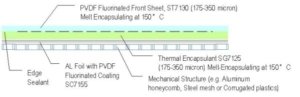
- SOLAR-TAB™ is a solar cell interconnection adhesive designed for cost-effective melt-tabbing to replace the traditional pre-tin tab soldering process for solar cell interconnections at a substantially lower temperature of 150°C.
- Melt-tabbing at less than 150°C dramatically reduces solar cell stress induced by traditional solder tabbing.
- SOLAR-TAB™ melt-tabbing provides instant bonding and enables the use of direct lamination process for solar cells interconnections in solar panel manufacturing.
- SOLAR-TAB™ conductive tab is made for ambient storage.
- Besides automated melt-bonding lamination, traditional manual soldering irons can be used to melt-bond the SOLAR-TAB™ conductive tab directly onto solar cells and their interconnections.
- SOLAR-TAB™ is available pre-applied on passivated copper for melt-bonding interconnections to maintain long-term low contact resistance.
- SOLAR-TAB™ ST8150-DS and ST8150-SS melt-tabbing is available as an adhesive on both sides of the metal tab or as a film on a single side of the metal tab.
- The SOLAR-TAB™ film adhesive application uses proven fluorinated polymers and a patented process to ensure long-term contact resistance as low as traditional solder-tabbing.
For a recommendation, information or assistance, please contact AIT sales and engineering:

AIT technical sales and service department can also be reached at: 1-609-799-9388 or 1-800-735-5040 (EST) and Fax: 609-799-9308